Wandering Goat Coffee
Sumatra Aceh
Sumatra Aceh
Couldn't load pickup availability
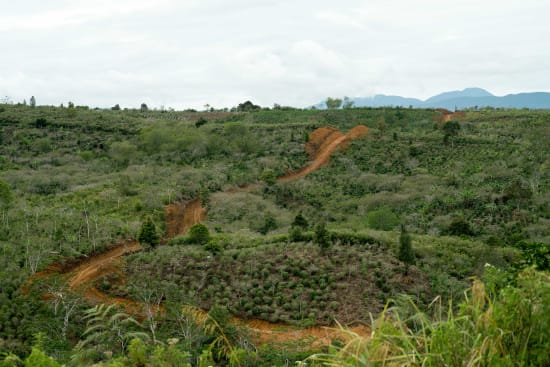
Aceh, in northern Sumatra, is an incredible region for coffee production. The average farm is one hectare, 80% of producers within northern Sumatra are women, and 95% of producers are smallholders. The region is diverse, geographically speaking. It is surrounded by beaches with a swampy inland, and the Barisan Mountains make up the inner two-thirds of the area. Coffee is grown on this volcanic mountain amongst the rainforest. One of the notable features of this area is Lake Taboa, the largest volcanic lake in the world.
Koperasi Produsen Putra Tani Berkarya (KPPTB) is a cooperative founded in 2022 by the younger generation of farmers in the regions of Bener Meriah and Aceh Tengah (Central Aceh). Members live in or near nine villages in the area. Farms are traditionally passed down from generation to generation. The coop currently consists of around 708 farmers.The Bener Meriah and Central Aceh regions are famous for producing Gayo coffee because of their cool climate, large hills, and volcanic soil. There is an active volcano in the area. KPPTB has its own processing unit with a drying area, huller, suton, sorting room, and storage room. The coop collects fresh-picked red cherries from its farmer members and brings them to the unit to be processed. They work hard to maintain a high quality for each export.
Sumatran coffees have long been distinct for their earthy, savory, somewhat vegetal or herbaceous characteristics, in part contributed by the climate and the mix of varieties grown, but also due to a specific post-harvest processing style called Wet-Hulling, or locally known as Giling Basah, which imparts much of the unique qualities these coffees have.Before the 1970s, coffees in Sumatra were processed in the two most commonly found methods worldwide: washed and natural. In the 1970s, Japanese interest in Sumatran coffees led to the introduction of the Wet-Hulled process, a unique style of handling and drying that is largely responsible for Sumatran coffees’ unmistakable flavor characteristics, but also their normally greenish-blue hue.In Sumatra, coffee farmers will typically harvest their coffee cherry and depulp them by hand at their farm or home. The coffee then dries for a very short time and is brought either to a coffee marketplace or to a “collector,” or collection point, where the beans are purchased at anywhere from 30–50% moisture, with their mucilage still partially intact. The coffee is then combined and hulled (has its parchment removed) while it is still in this high-moisture state. The coffee is then dried to the more commonly globally accepted 11–13% moisture in order to prepare for export.While there is some experimentation currently being done with large-scale Washed coffee for export, most of the Washed coffee produced is for local consumption. The Wet-Hulled process was developed specifically to speed up drying and efficiency in a climate that sees heavy rain and clouds most of the year. Removing the parchment layer allows the coffee to dry much faster on patios or tarps even in these conditions.
Free shipping on all bulk coffee orders of five-pounds and more.
Pickup and whole beans are available every day from 7AM-3PM from our cafe.
Share